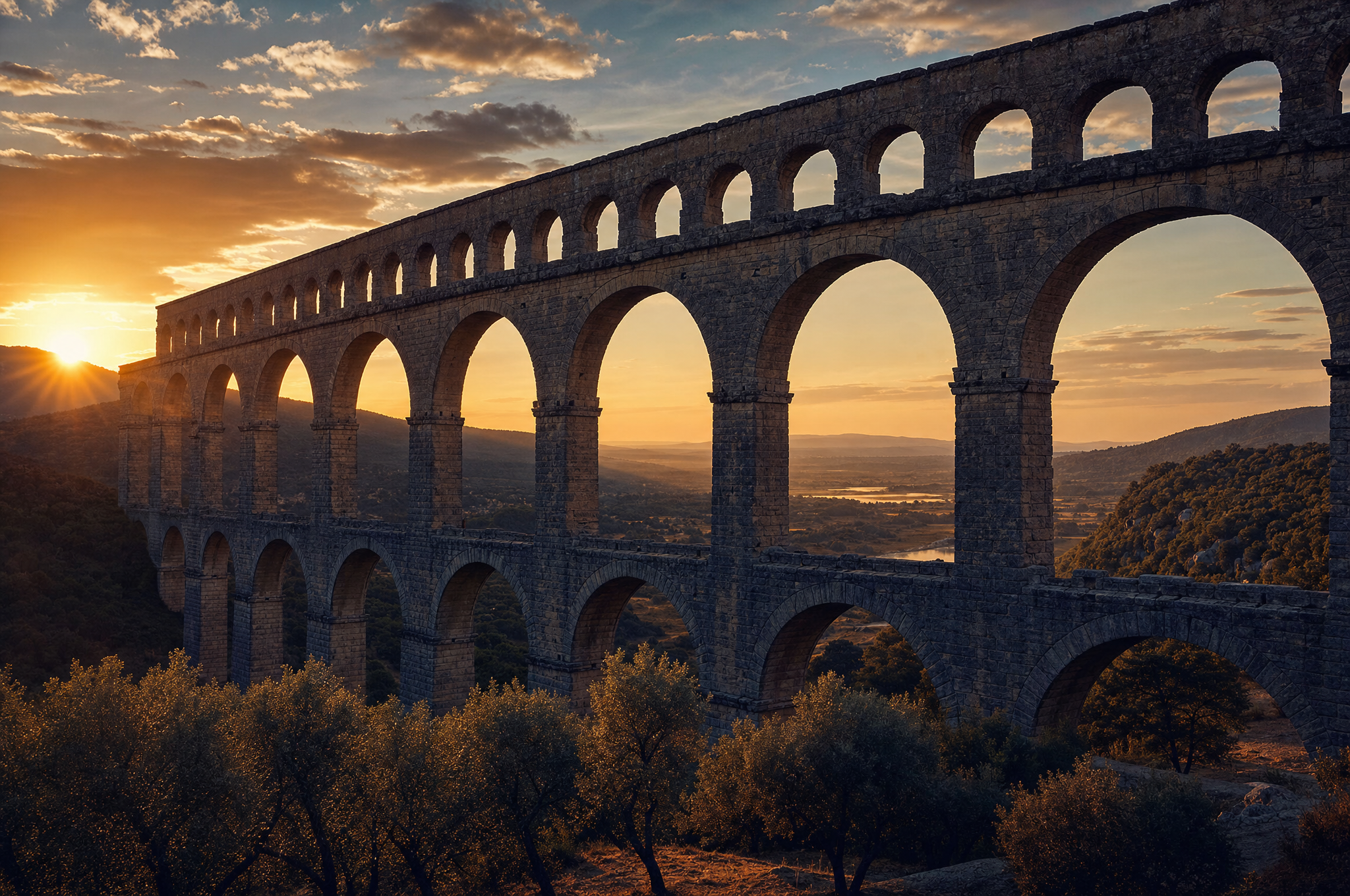
Standing beneath the Pont du Gard in southern France — a three-tiered stone bridge that rises 48 meters above the Gardon River — it's hard to believe it was built 2,000 years ago. No mortar holds the stones together. No steel reinforces the arches. No computers calculated the loads. And yet it stands, as it has stood since the first century AD, carrying nothing now but the weight of its own magnificence. It was built as part of an aqueduct system that carried water 50 kilometers to the Roman city of Nemausus (modern Nîmes), dropping just 17 meters over that entire distance — a gradient of 1 in 3,000. That's not engineering by guesswork. That's engineering by genius.
The Scale of Roman Water Engineering
Rome's aqueduct system was, by any measure, one of the most ambitious engineering projects of the ancient world. At its peak, around 226 AD, the city of Rome was served by eleven major aqueducts that collectively delivered an estimated 1 million cubic meters of water per day — enough to supply a population of over a million people with a per capita water supply that wouldn't be matched in Europe until the 20th century.
The aqueducts weren't just for drinking water. They fed public baths, fountains, latrines, industrial operations, and even the elaborate water displays in wealthy households' gardens. The system was so extensive that Roman water engineers — called aquarii — were a specialized professional class, responsible for maintenance, repairs, and water distribution.
The Gradient: Precision Without Instruments
The most astonishing aspect of Roman aqueduct engineering is the gradient. Water flows downhill — that's obvious. But to carry water over long distances without it either stagnating (too flat) or eroding the channel (too steep), the aqueduct needed to maintain a precise, consistent slope. Roman engineers typically aimed for a gradient of about 1 in 3,000 to 1 in 200 — that is, a drop of roughly 1 meter for every 200 to 3,000 meters of horizontal distance.
To put this in perspective: the aqueduct of Nîmes, which includes the Pont du Gard, drops just 17 meters over 50 kilometers. That's an average gradient of about 1 in 3,000 — roughly 34 centimeters per kilometer. This is a slope so gentle that it's nearly imperceptible to the human eye, yet the Romans maintained it consistently over 50 kilometers of varied terrain, through tunnels, across valleys, and over ridges.
The gradient of the Nîmes aqueduct averages about 1 in 3,000 — a drop of 17 meters over 50 kilometers. Achieving this without modern surveying instruments is one of the great feats of ancient engineering.— On the precision of Roman aqueduct gradients
How did they achieve this without lasers or levels? Roman surveyors used an instrument called a chorobates — a long wooden beam, about 6 meters long, with a flat top and plumb lines at each end. By sighting along a series of chorobates, surveyors could establish a level line and then calculate the required drop. It was painstaking, labor-intensive work, but it was accurate enough to produce gradients that modern engineers regard as impressive even by today's standards.
The Arches: Why They Still Stand
The most visually iconic feature of Roman aqueducts is the arcade — the series of stone arches that carried the water channel across valleys and low ground. The arch is the key to Roman structural engineering, and its genius lies in how it handles weight.
A flat beam (a lintel) supports weight by bending — the top compresses and the bottom stretches. Stone is excellent in compression but weak in tension, so a stone lintel can only span a limited distance before cracking. An arch, by contrast, converts the downward force of weight into outward, compressive forces that travel around the curve of the arch and down into the supporting pillars. Everything is in compression — and stone handles compression beautifully. This is why Roman arches could span much larger distances than flat stone beams, and why they've survived for two millennia.
The Pont du Gard's arches are built with precisely cut stone blocks called voussoirs, wedge-shaped so that each block presses against its neighbors under compression. No mortar is used — the structure is held together entirely by the geometry of the arch and the friction between stones. The largest stones weigh up to 6 tons, and each was cut to fit precisely without the benefit of modern cutting tools.
Roman Concrete: The Secret Material
While the famous arched portions of aqueducts were built of cut stone, much of the water channel itself — and many other Roman structures — was built of opus caementicium, Roman concrete. And Roman concrete was, in some ways, superior to modern Portland cement concrete.
Roman concrete was made from a mixture of lime mortar, volcanic ash (pozzolana), and aggregate (gravel and rubble). The volcanic ash was the key ingredient: when mixed with lime and water, it triggered a chemical reaction (a pozzolanic reaction) that produced a binder extraordinarily resistant to chemical attack and water erosion. Modern Portland cement, by contrast, degrades over decades when exposed to water and salt.
Recent research has revealed something even more remarkable: Roman concrete actually gets stronger over time. Seawater filtering through the concrete triggers the growth of crystalline minerals (aluminum tobermorite) that fill microcracks and reinforce the structure. This is why Roman harbor structures — like the breakwaters at Caesarea or Pozzuoli — have survived 2,000 years of wave action while modern seawalls crumble in decades.
Key Takeaway
Roman aqueducts relied on three engineering innovations: precise gradient control (achieved with the chorobates surveying tool, maintaining slopes as gentle as 1 in 3,000), the compressive arch (converting weight to compression, which stone handles perfectly), and opus caementicium (Roman concrete using volcanic ash, which actually strengthens with age). Together, these allowed structures that have survived 2,000 years.
The System: More Than Just Arches
The arched arcades are the famous part, but they were actually a minority of any aqueduct's length. Most of an aqueduct ran underground or at ground level, through trenches and tunnels. The Pont du Gard's visible arches represent only about 1% of the Nîmes aqueduct's total length — the other 49+ kilometers ran underground.
The underground portions featured their own engineering marvels:
- Inspection shafts: Dug at regular intervals (typically every 70 meters), these allowed aquarii to descend into the channel for inspection and cleaning.
- Sedimentation tanks: At key points, the channel widened into basins where water flow slowed, allowing sediment to settle out before the water continued.
- Inverted siphons: When a valley was too deep to bridge with arches, Roman engineers used siphons — pressurized pipes that carried water down one side of the valley and up the other, using the principle that water seeks its own level.
- Distribution tanks (castella): At the city end, water flowed into a distribution tank that split the flow into separate pipes for public fountains, baths, and private customers (who paid a fee for the privilege).
Why They Still Stand
The survival of Roman aqueducts — some still carrying water today, like the Acqua Vergine which feeds the Trevi Fountain — is not an accident. It's the result of several converging factors:
- Over-engineering: Roman structures were built with massive safety margins. Walls were thick, arches were robust, and materials were used generously. They were designed to last, not to minimize cost.
- Compressive design: Because Roman engineering relied on compression rather than tension, there's no metal to rust, no tension members to fail. The structure's stability comes from geometry and mass, not from components that degrade.
- Self-healing concrete: The pozzolanic concrete actually strengthens over time, as mineral growth fills cracks. A Roman concrete structure may be stronger in 2026 than it was in 100 AD.
- Continuous maintenance: Some aqueducts have been in continuous use for 2,000 years, which means they've been continuously maintained. A structure that's used is a structure that's cared for.
- Material quality: The volcanic ash used in Roman concrete was of exceptionally high quality, and the stone used for arches was chosen for durability.
The Legacy
Roman aqueduct engineering influenced water systems for centuries. The principle of gravity-fed water supply, the use of arches for spanning valleys, and the concept of a public water infrastructure all persisted long after the Roman Empire fell. Medieval European cities that had been Roman settlements often continued using (and repairing) Roman aqueducts, and the engineering principles spread to Islamic civilization, which built its own sophisticated water systems.
The lesson of Roman aqueducts is not that ancient people were smarter than us — they weren't, and they had far fewer tools. The lesson is about the power of getting fundamentals right. The Romans understood compression, gravity, and flow. They built with materials that lasted. They over-engineered for safety. And they maintained what they built. Two thousand years later, we're still marveling at the result — and still struggling, in many cases, to match it.
Fascinated by ancient engineering? The Romans weren't the only ones to solve problems that lasted millennia. Explore why barns are painted red — a more modest but equally enduring example of practical chemistry becoming tradition.