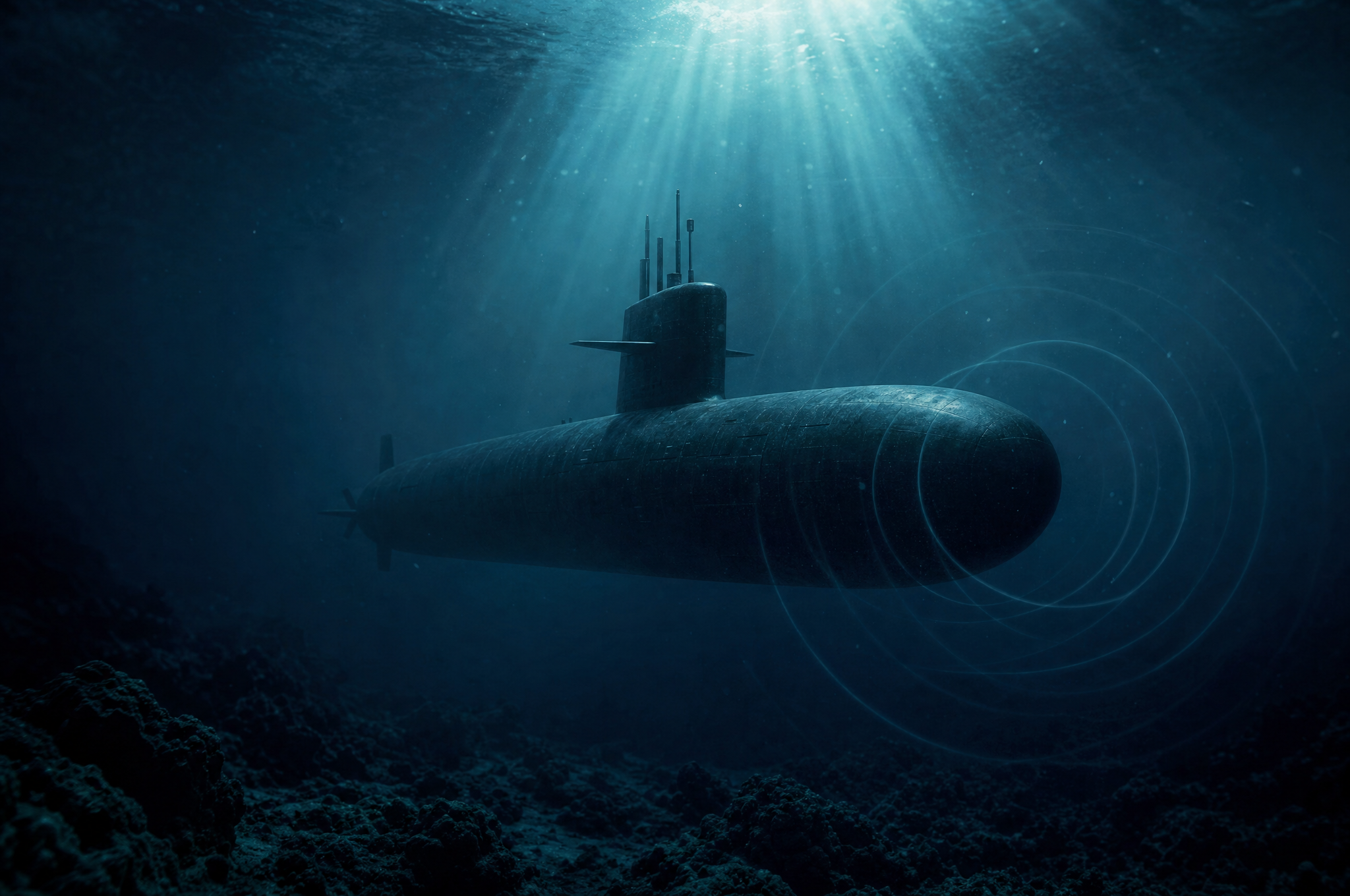
Picture this: two nuclear submarines, each longer than a football field, are somewhere in the Pacific Ocean. The water is pitch black at their operating depth. Radio waves barely penetrate seawater. GPS is useless. Radar reflects off the surface, not down into the depths. And yet, these submarines must avoid each other, track each other, and — in military contexts — find each other on purpose. How do they do it? The answer involves one of the most counterintuitive facts in physics: in the ocean, sound is king.
Why can't submarines just use radar or radio like ships and planes do?
Because electromagnetic waves — radar, radio, light — are absorbed by seawater within meters. The ocean is essentially opaque to them. Sound, on the other hand, travels through water roughly 4.3 times faster than through air, and it can travel enormous distances. A low-frequency sound wave in the right ocean conditions can be detected thousands of kilometers away. So submarines have evolved to use sound — sonar — as their primary sense.
What is sonar, and how does it work?
Sonar (Sound Navigation and Ranging) comes in two flavors. Active sonar works like a bat's echolocation: the submarine emits a "ping" of sound, then listens for the echo bouncing off objects. By timing the delay and measuring the echo's intensity, the submarine can calculate the distance, bearing, and even rough size of whatever reflected the sound. Passive sonar is different: the submarine simply listens — without making any sound of its own — to the noise produced by other vessels. Every ship and submarine has an acoustic signature: the hum of its machinery, the thrum of its propeller, the flow of water around its hull. Passive sonar detects and analyzes these signatures.
Active vs. Passive: The Stealth Paradox
Here's the central tension of submarine warfare: active sonar gives you precise information, but it also announces your presence to everyone within range. It's like turning on a flashlight in a dark room — you can see, but so can everyone else see you. A submarine that pings is effectively saying "I'm here" to any hostile sub within dozens of miles.
This is why modern submarines overwhelmingly rely on passive sonar. They sit in silence, listening. A skilled sonar operator can identify the type of ship, its speed, and even its direction of travel just from the acoustic signature. The tradeoff is that passive sonar is less precise about distance — you can tell something is out there, but triangulating exactly how far away requires either multiple hydrophones (underwater microphones) or movement over time to create parallax.
The golden rule of submarine operations: silence is survival. You listen first. You ping only when you absolutely must.— Summary of decades of submarine doctrine
The Physics of Sound in Water
Sound travels through seawater at approximately 1,500 meters per second — compared to about 343 m/s in air. But the speed isn't constant. It varies with water temperature, salinity, and pressure (depth). This variation creates something remarkable called the SOund Fixing And Ranging (SOFAR) channel, a layer of the ocean where sound gets trapped and can travel extraordinary distances.
Here's how it works: as sound waves move through water, they refract (bend) toward regions where sound travels more slowly. At certain depths — typically around 1,000 meters in mid-latitudes — there's a minimum in the sound speed profile. Sound waves that enter this channel at a shallow angle get trapped, bouncing back and forth within the channel rather than escaping. The result: a low-frequency sound can travel across an entire ocean basin with remarkably little loss of energy.
During the Cold War, the United States deployed arrays of hydrophones called SOSUS (Sound Surveillance System) to listen for Soviet submarines in the SOFAR channel. It worked astonishingly well — a submarine's machinery noise, carried by the SOFAR channel, could be detected from hundreds of kilometers away.
How Two Submarines Detect Each Other
When two submarines are in the same area, they're both playing the passive-listening game — which creates a eerie, mutual hide-and-seek. Each is trying to detect the other's acoustic signature while minimizing its own. Several factors come into play:
- Radiated noise: A submarine's machinery, cooling pumps, and propeller all produce sound. Modern submarines are extraordinarily quiet — nuclear submarines can reduce their noise to near-ambient ocean levels by going to "ultra-quiet" modes, shutting down non-essential systems.
- Background noise: The ocean is not silent. Waves, marine life (snapping shrimp alone create a constant crackle), distant shipping, and seismic activity all produce ambient sound that can mask a submarine's signature.
- Thermal layers: Temperature differences in the ocean create layers that bend sound waves. A submarine can hide beneath a thermal layer, and sound from above gets refracted away — a natural acoustic cloak.
The Close-Encounter Problem
If two submarines are both running silent, both may fail to detect each other until they're dangerously close. This has led to real collisions — the most notable being the 2009 collision between the British HMS Vanguard and the French Le Triomphant, both nuclear ballistic missile submarines. Neither detected the other until impact. The ocean is vast, but the submarines were operating in the same patrol area, and their near-silent running meant neither heard the other coming.
Key Takeaway
Submarines find each other primarily through passive sonar — listening for the other's acoustic signature without revealing their own position. Active sonar (pinging) is precise but reveals your location, so it's used sparingly. Sound physics, including the SOFAR channel and thermal layers, shape the entire cat-and-mouse game.
Modern Detection: Beyond Traditional Sonar
Traditional sonar isn't the only tool. Modern submarine detection has evolved to include several complementary technologies:
- Towed array sonar: A long cable studded with hydrophones, trailed far behind the submarine to get it away from the sub's own noise. These arrays can be hundreds of meters long and dramatically improve detection range.
- Non-acoustic detection: Satellites can sometimes detect the subtle surface wake a submarine leaves, or the thermal signature of the warm water it pumps out. Magnetic anomaly detectors (MAD) on aircraft can sense the distortion a steel hull creates in Earth's magnetic field.
- Distributed networks: Underwater sensor networks, like modern descendants of SOSUS, can detect and triangulate submarine signatures across vast ocean areas.
But the fundamental game hasn't changed. In the ocean's darkness, the quietest submarine has the advantage. Detection is a contest of acoustic stealth — and the ocean, with its layers, channels, and ambient noise, is both the battlefield and the referee.
The next time you stand at the ocean's edge, consider what's happening beneath the surface: a silent, invisible war of listening, where the most powerful military machines ever built are reduced to holding their breath and waiting for a sound.
Interested in how other animals navigate the depths without sonar? Read our piece on how migratory birds navigate across oceans — they face a different challenge, but their solutions are equally ingenious.