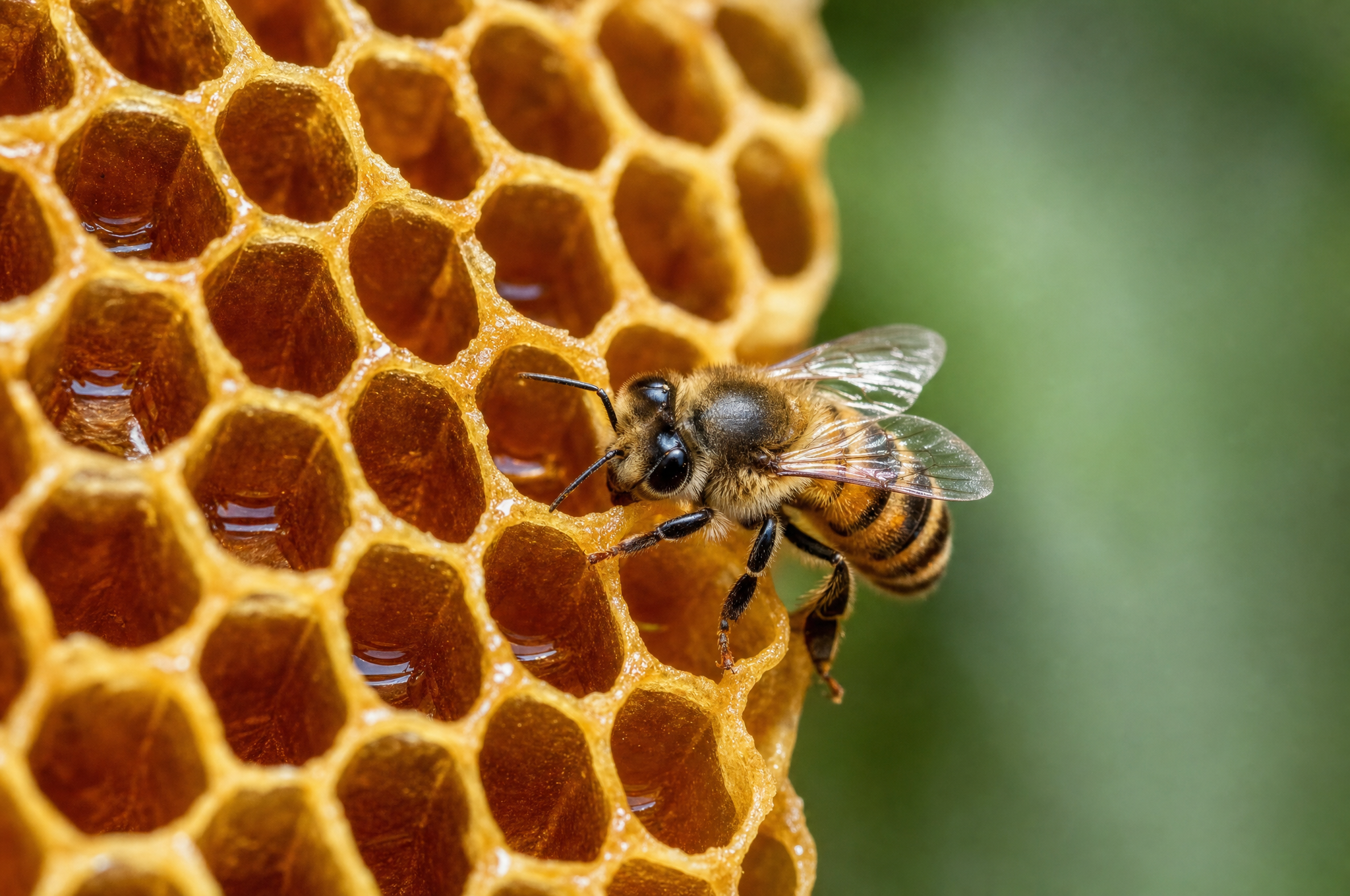
In the fourth century BC, a Greek scholar named Pappus of Alexandria looked at a honeycomb and asked a question that would take more than two thousand years to answer: why hexagons? Bees could build their storage cells as circles, triangles, squares, or any other shape. They choose hexagons — six-sided polygons — and they build them with a precision that would embarrass most human engineers. What Pappus suspected, and what modern mathematics eventually proved, is that bees aren't just being tidy. They're solving one of nature's most elegant optimization problems.
The Problem: Maximum Storage, Minimum Wax
To understand why hexagons are special, we need to understand the bees' constraints. Honeybees build comb to store honey, pollen, and their own larvae. The comb is made of beeswax, which the bees produce by consuming honey — it takes roughly eight grams of honey to produce one gram of wax. Wax is biologically expensive. So bees need to enclose the maximum possible storage area using the minimum possible amount of wax.
Imagine you're tiling a flat surface with identical cells. You want each cell to have a large interior and a small perimeter (since perimeter = wax used). Which shape tiles the plane while minimizing perimeter for a given area? There are only three regular polygons that can tile a flat surface without gaps: triangles, squares, and hexagons. Circles, for instance, leave gaps. Pentagons don't tile at all.
Comparing the Contenders
Let's compare the three shapes that can tile the plane, each with the same area (let's say 1 square unit):
| Shape | Perimeter | Wax Efficiency |
|---|---|---|
| Equilateral Triangle | 4.56 units | Poor |
| Square | 4.00 units | Good |
| Regular Hexagon | 3.72 units | Best |
The hexagon has the smallest perimeter — and therefore uses the least wax — for a given enclosed area. The difference isn't trivial: compared to squares, hexagons save about 7% in perimeter. Compared to triangles, they save roughly 18%. Over an entire honeycomb with thousands of cells, that adds up to a significant conservation of honey and energy.
Pappus Knew — But Couldn't Prove It
Pappus of Alexandria, writing around 320 AD, observed this in his work "Mathematical Collection." He recognized that hexagons were the most efficient of the three tiling shapes and argued that bees must be using them for precisely this reason — a remarkable early insight into what we'd now call optimization in nature.
But Pappus only compared the three regular tilings. He couldn't prove that no irregular shape — some weird curved-sided polygon, perhaps — might do even better. Mathematicians are a cautious lot, and "it looks like the best option among the obvious choices" is not the same as "it's provably the best option among all possible choices." This distinction matters. The claim that hexagons are the absolute most efficient way to tile a plane became known as the Honeycomb Conjecture, and it remained unproven for centuries.
The Proof: 2,000 Years Later
It wasn't until 1999 — yes, 1999 — that a mathematician named Thomas Hales finally proved the Honeycomb Conjecture. Hales, a professor at the University of Michigan (later at the University of Pittsburgh and the University of Warwick), demonstrated that no division of the plane into equal-area regions can have a smaller total perimeter than the regular hexagonal tiling. Not just among the three obvious shapes — among all possible shapes.
The honeycomb conjecture asserts that any partition of the plane into regions of equal area has perimeter at least that of the regular hexagonal honeycomb tiling.— Thomas Hales, "The Honeycomb Conjecture" (2001)
Hales's proof was rigorous and definitive. The hexagon isn't just the best of the three regular tilings — it's the best possible tiling, period. Bees, through millions of years of evolution, had arrived at the same answer that took human mathematics two millennia to verify.
Key Takeaway
Hexagons are the mathematically optimal shape for tiling a flat surface with equal-area cells while minimizing perimeter. Bees evolved this solution through natural selection — those that used less wax survived and reproduced more efficiently. Thomas Hales proved it definitively in 1999.
But Do Bees Really "Know" Math?
Here's the humbling part: bees don't know any of this. They don't calculate perimeters or compare tiling efficiencies. What actually happens is that the bees build circular cells initially, and as they construct neighboring cells, the soft wax bulges outward. Surface tension — the same force that makes soap bubbles spherical — pulls the wax walls into hexagonal shapes as they cool and harden.
In other words, the hexagon emerges from physics, not calculation. Each bee is just building a round cell next to other round cells, and the wax naturally settles into the most efficient configuration. It's a beautiful example of what scientists call emergent behavior — a complex, optimal pattern arising from simple rules, without any individual agent understanding or intending the result.
Hexagons Beyond the Hive
The hexagon's efficiency isn't just a honeycomb curiosity. The same principle appears throughout nature and engineering:
- Bubble rafts: When soap bubbles cluster on a flat surface, they naturally form hexagonal patterns — surface tension solving the same optimization problem.
- Volcanic columns: The famous Giant's Causeway in Northern Ireland features thousands of hexagonal basalt columns, formed as cooling lava contracted and cracked along the most efficient stress lines.
- Engineering: Hexagonal grids are used in aerospace materials (honeycomb sandwich panels) because they provide maximum strength with minimum material.
- Dragonfly eyes: The compound eyes of many insects use hexagonal lenses — nature's way of packing the maximum number of optical units into a curved surface.
The Beauty of Convergent Solutions
What makes the honeycomb story so compelling is that it's not really about bees. It's about the deep tendency of the universe to favor efficient solutions. When a problem has a clear optimum — minimum perimeter for maximum area, in this case — evolution, physics, and mathematics all converge on the same answer. Bees found it through natural selection. Bubbles find it through surface tension. Mathematicians found it through proof. They all arrive at the hexagon.
So the next time you see a honeycomb, don't just admire the honey. Admire the geometry — and the fact that you're looking at a solution to a problem that the human mind needed two thousand years to fully verify, solved by a creature with a brain the size of a sesame seed.
Want more on nature's hidden mathematics? Explore our article on how migratory birds navigate — they use quantum-level physics that's equally astonishing.